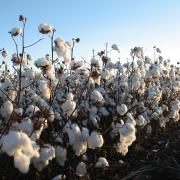
On-farm demonstration sites will give growers the opportunity to use and see low-emission technology first-hand.
Without specifically focusing on reducing GHG emissions, by increasing their input efficiencies, some growers over many years would have been improving their emission levels. Installing irrigation systems with fewer pumping requirements, using enhanced efficiency fertilisers and variable rates, utilising robots, and improving crop residue/stubble management are helping growers reduce their emissions and improve their triple bottom line. Enhancing native vegetation and soil health may also increase the ability of a cotton farming system to sequester carbon.
Cotton industry researchers have illustrated that Australian conditions and farming practices do not lend themselves to easily achieving net zero (i.e. where carbon sequestered offsets the climate change impact of GHGs emitted) due to emissions sources that cannot be avoided. These include natural processes such as decomposing crop residues and microbial activity in the soil, and the lack of low emissions inputs such as green nitrogen (N) fertiliser (see full story in Spotlight Summer 2024–25).
As a result, CRDC’s science-based ambition is to help growers to reduce emissions as much as technically possible through reducing reliance on fossil fuels on-farm, reducing on-farm emissions from N, and improving soil health.
CRDC Innovation Broker Dr Nicola Cottee says through these three major pathways, cotton growers have the opportunity and potential to create low-emission-intensity farming systems.
“Growers are keen to know more about what these pathways entail, and most importantly, how to capture value from reducing emissions,” Nicola said.
Supporting growers through CottonLEIFS
To meet this challenge, CRDC has invested in an extensive project created by CRDC’s sister organisation, the Grains Research and Development Corporation (GRDC), that is taking an innovative approach: working directly with growers so they can be supported to plan and implement emissions reduction strategies and calculate and report the emissions intensity of their crops. It’s an important blend of research, development and extension (RD&E).
“The Cotton Low Emission Intensity Farming Systems project (CottonLEIFS) is about facilitating the transition on-farm in line with what makes sense for the grower’s business,” Nicola said.
“I’ve had a lot of feedback from growers around understanding the value proposition for thinking about carbon or investing in emission reductions. They want to know what their options are, what they need to do, why and when.
“Cotton growers will be integral to the project, and we are looking forward to working with scientists at the research sites and growers to create demonstration sites.
“The opportunities for growers who would like to be involved include trialling emission reduction technologies on-farm in a low-risk environment, which could be particularly important for N fertilisers, where risk is such a big driver for decisions (see story in Spotlight Summer 2024–25).”
Research, collaboration and demonstration sites
CottonLEIFS is working with the NSW DPIRD Farms of the Future project to demonstrate technologies that can monitor crops and inform decisions that will result in reduced GHGs from cotton production systems, and the On-Farm Carbon Advice project that is educating farmers on GHG emissions in agricultural systems.
“Participating farmers will walk away from CottonLEIFS with a carbon plan, will have tested options for reducing emissions in a way that aligns with their farming system and business objectives, and will understand options for capturing value from their on-farm emissions reductions.
“In return, we ask that they open their gates to share their carbon experience with other growers and consultants.”
CottonLEIFS will be primarily delivered through a NSW Action Research Network, managed by Dr Aaron Simmons, a senior research scientist of the NSW DPIRD Climate Branch.
“Our intention is to have on-farm demonstrations for GHG emission reduction strategies that we have confidence in, located throughout the cotton growing regions of NSW, and I’d really encourage farmers interested in hosting a site to submit an expression of interest when they are released,” Aaron said.
Research demonstration hubs
In addition to on-farm demonstration sites, three research demonstration hubs for cotton will be established: at the Australian Cotton Research Institute (ACRI) near Narrabri, Trangie Agricultural Research Centre, and in southern NSW (location to be confirmed). These research hubs will be used to demonstrate emerging GHG emission reduction strategies. CRDC will be looking at ways to evaluate the NSW program to roll out a similar initiative in other states.
“CottonLEIFS will also trial and demonstrate technology to automate the calculation of the emission intensity of cotton at the paddock scale and the supply of the emission intensity to the supply chain,” Aaron said.
“There will be a mix of facilitated activities such as demonstration site open days and more resources for growers through networks such as CottonInfo.”
Growers interested in hosting a demonstration site can submit an Expression of Interest to action.research.networks@dpi.nsw.gov.au.
This article originally appeared in the Autumn 2025 edition of CRDC's Spotlight magazine. You can read this edition online here, and subscribe for future editions here.